Barentsburg and Pyramiden: Two Different Ways Russia Never Really Left the Arctic

Inside the silent logic of strategic presence, Arctic geopolitics and long-term positioning in Svalbard
by Adelio Debenedetti, author of The Naacal Protocol – Code 211
The Arctic contains places that survive for reasons that have very little to do with economics. At first glance, Barentsburg and Pyramiden look like relics of another era — isolated Soviet mining settlements suspended between ice, fog and polar silence inside the Norwegian archipelago of Svalbard. But the deeper one looks, the clearer it becomes that these settlements are not simply historical remnants. They are geopolitical infrastructure. In a century increasingly shaped by Arctic geopolitics, strategic chokepoints and grey zone competition, both Barentsburg and Pyramiden reveal how modern powers maintain influence not only through military force, but through continuous presence inside legally ambiguous territory. That distinction matters far more than most people realize.
Barentsburg and the logic of permanent presence
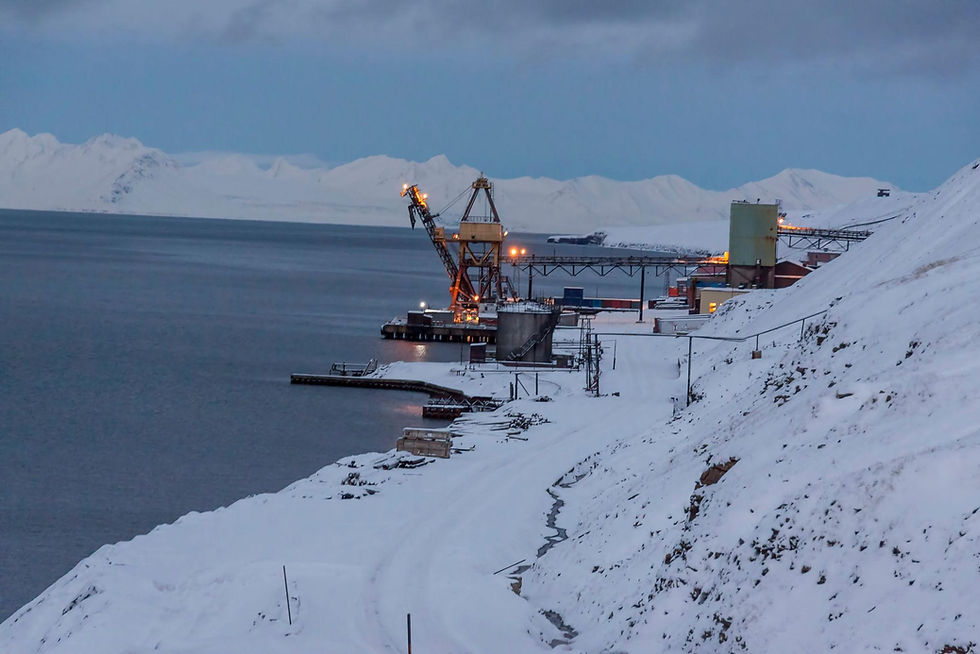
Barentsburg is still alive. The mining settlement continues operating under Russian management through the state-owned company Arktikugol, even though the economic rationale behind Arctic coal extraction has weakened dramatically over time. Maintaining the town is expensive.Logistics are difficult.Production is limited.The global coal market itself has changed. Under normal market conditions, the settlement would probably have disappeared decades ago. Instead, it survives through Russian state support. And that changes the meaning of the settlement entirely. Barentsburg is no longer simply an industrial site. It has become a strategic foothold maintained through economic loss in exchange for geopolitical continuity. The logic is simple:remaining present inside Svalbard matters more than profitability. Under the Svalbard Treaty, maintaining civilian activity allows foreign powers to preserve practical influence within the archipelago. Population, infrastructure, logistics and continuity become forms of long-term geopolitical positioning. In the Arctic, geography amplifies presence. A harbor is never just a harbor.An airstrip is never just an airstrip.A mining settlement is never entirely civilian. This is where Barentsburg enters the realm of modern grey zone geopolitics. The infrastructure remains formally civilian, yet its strategic value extends well beyond economics. Ports, communications systems, energy facilities and Arctic logistics networks can all acquire dual-use significance without officially becoming military installations. The settlement therefore exists inside a carefully maintained ambiguity: civilian by law, strategic by consequence.
Pyramiden and the strategy of latent infrastructure

And then there is Pyramiden. Unlike Barentsburg, Pyramiden officially died in 1998 when mining operations ended. The Soviet-era settlement was abandoned after years of declining profitability and logistical difficulty. Yet even today, the town remains strangely intact. Buildings still stand frozen in time.The harbor still exists. Limited Russian presence continues.The settlement is preserved rather than dismantled. That detail is far more important than it appears. Because Pyramiden represents a different model of Arctic permanence. Barentsburg is active presence.Pyramiden is latent presence. One costs money to operate.The other costs relatively little to preserve. But both achieve the same strategic effect:Russia never fully disappears from the territory. Pyramiden is particularly revealing because it occupies a space between categories.
It is not truly a functioning city. It is not entirely abandoned either. It exists in a suspended condition that perfectly reflects the broader ambiguity of Arctic geopolitics itself. And this is precisely the type of environment where modern strategic competition thrives. Grey zone conflict rarely depends on direct confrontation. Instead, it operates through continuity, ambiguity and infrastructure capable of acquiring strategic value over time. In this sense, Pyramiden may actually be more revealing than Barentsburg. It demonstrates how maintaining dormant infrastructure can itself become a geopolitical instrument.
Arctic geopolitics and strategic positioning in the High North

The Arctic increasingly rewards long-term positioning over immediate economic logic. States are investing not only in military capabilities, but in future optionality: preserving access,legal continuity,logistical relevanceand physical presence inside territories whose strategic importance continues to grow. That trend extends far beyond Svalbard. Across the Arctic, infrastructure once considered peripheral is acquiring new relevance because of:polar shipping routes,satellite monitoring systems,undersea communications,energy competitionand Arctic surveillance architecture. What once appeared remote now sits much closer to the center of global strategic planning. This is also why the GIUK Gap matters again. The maritime corridor between Greenland, Iceland and the United Kingdom remains one of NATO’s critical North Atlantic strategic chokepoints, linking Arctic geopolitics to submarine routes, undersea infrastructure protection and wider North Atlantic security calculations. Svalbard exists directly inside this evolving strategic geography.
Hybrid warfare and the future of Arctic competition
Settlements like Barentsburg and Pyramiden reveal something larger about modern power itself:states no longer need overt militarization to shape influence. Sometimes remaining physically present inside ambiguous territory is enough. The future of Arctic strategy will likely depend less on visible military confrontation and more on: logistics, infrastructure, surveillance, legal positioning, civilian continuity and permanent strategic presence. This is one of the defining characteristics of modern hybrid warfare. The Arctic is no longer an empty frontier at the edge of the map. It is becoming a laboratory for the future of geopolitical competition — a region where civilian infrastructure, legal frameworks, strategic corridors and silent persistence may matter more than conventional displays of force. And in places like Barentsburg and Pyramiden, the Cold War never completely ended. It simply adapted to the geography of the 21st century.
This article is part of the Grey Zones Archive editorial project, a long-form analysis series focused on Arctic geopolitics, strategic chokepoints, cognitive warfare, hybrid conflict, dual-use infrastructure and the evolving balance of power in the 21st century. The analyses published on The Naacal Protocol Blog explore the increasingly blurred line between intelligence, strategic geography and contemporary geopolitical narratives, in continuity with the research-based universe of The Naacal Protocol – Code 211 by Adelio Debenedetti.


Comments