Greenland was never the question
What a passing remark at 2018 AIPAC reveals about global strategic corridors
by Adelio Debenedetti, author of The Naacal Protocol – Code 211
In Washington, strategy rarely arrives as a declaration. It emerges slowly, often disguised as rhetoric, sometimes even as a joke. Years before Greenland entered mainstream political debate in the United States, Benjamin Netanyahu posed a question during a speech at 2018 AIPAC that, at the time, sounded almost out of place. What are we going to do about Greenland?
The line passed quickly. No policy followed. No explanation was required. It remained what it appeared to be: a remark on the margins of a broader discussion. Only later did it begin to carry weight. Not because it revealed intent, but because it reflected a shift that had already begun elsewhere, beyond public visibility.
When geography moves before politics reacts
For most of modern history, Greenland has been treated as a geographic excess. A vast, frozen space that existed on maps but rarely in strategic conversations. That perception is no longer tenable. As Arctic ice recedes, routes once considered impractical are becoming operational. Distances between Asia, Europe and North America are shrinking in ways that alter both trade and military timelines. What used to be an obstacle is turning into passage. And in geopolitics, passages are never neutral. This transformation did not happen overnight. It is the result of a gradual change that strategy absorbed long before politics acknowledged it.
The return of a familiar logic
During the Cold War, control of access points defined the balance of power. One of the most critical was the GIUK Gap, the corridor between Greenland, Iceland and the United Kingdom. It was more than a geographic feature. It was a filter. Soviet submarines moving into the Atlantic had to cross it. NATO built surveillance systems around it. Controlling that space meant controlling movement itself. When the Cold War ended, that system did not disappear. It simply faded from public attention. Today, it is resurfacing, not as a relic, but as part of a broader architecture shaped by Arctic transformation.
A remark that understood timing
Netanyahu’s question did not need to be a policy statement. Its relevance lies elsewhere. By introducing Greenland into a high-level conversation, even briefly, it acknowledged that certain geographies were already being reconsidered within strategic circles. It did not instruct. It suggested. In that sense, it functioned less as a statement and more as a signal. Not to provide answers, but to test whether the question itself could be asked. This is how grey zone dynamics often unfold. Strategic shifts are rarely announced. They are normalized.
Not territory, but infrastructure
Understanding Greenland today requires a change of perspective. It is not simply land. It is a system. Radar installations, early-warning capabilities, satellite tracking and control over emerging Arctic routes converge in a single space. The U.S. presence on the island, most visibly through installations like Thule Air Base, is not an anomaly. It is continuity. Infrastructure of this kind is rarely dismantled. It is maintained, adapted, and, when necessary, reactivated. The conditions for that reactivation are now visible.

When politics arrives late
When Donald Trump later raised the possibility of acquiring Greenland, the proposal was widely perceived as unconventional. But the reaction revealed something else. By the time the idea surfaced in political discourse, the strategic conversation had already taken place elsewhere. Arctic routes, resource access and military positioning had long been part of internal assessments.
What appeared sudden was, in reality, delayed.
The map is no longer what it was
The significance of that earlier remark lies not in its content, but in its timing. It reflects a broader shift in how space is understood. Power is no longer defined only by territory, but by the ability to manage flows. Shipping lanes, data routes, energy corridors and military projection are now interconnected. In this framework, Greenland is not remote. It is connective. It sits between systems, linking the Arctic to the Atlantic, and reconnecting older strategic architectures to emerging realities.
Beyond Greenland
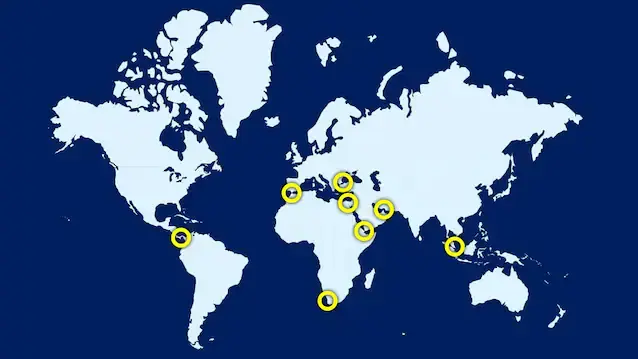
The question, ultimately, was never about Greenland. It was about recognizing that the map itself was changing. And once that shift is understood, other regions begin to appear in the same light. Different geography, same logic. From the Arctic to the Strait of Hormuz, the pattern repeats.
Control the corridor, and you influence the system. Ignore it, and you fall outside of it.

Comments