Iran vs United States: Why This Conflict Is Structural Understanding the geopolitical logic behind a permanent tension

By Adelio Debenedetti, author of The Naacal Protocol – Code 211
The conflict that never really disappears
Every few months the same question returns. Are Iran and the United States heading toward war? Missile launches, sanctions, naval incidents in the Persian Gulf, proxy clashes across the Middle East. The cycle repeats so regularly that it often looks like a sequence of crises rather than a single conflict. But the reality is simpler. The tension between Washington and Tehran is not episodic. It is structural. And like all structural conflicts in geopolitics, it does not depend on the personalities of leaders or on temporary diplomatic tensions. It depends on geography, power, and the logic that governs regional balances.
Before the revolution: Iran was an American pillar
For much of the Cold War, Iran was not an enemy of the United States. It was the opposite.
Under Mohammad Reza Pahlavi, Iran represented one of Washington’s key strategic partners in the Middle East. Its role was simple: help stabilize the Persian Gulf and contain Soviet influence in the region. Everything changed in 1979. The Iranian Revolution overthrew the Shah and replaced him with a revolutionary regime that rejected Western influence and claimed strategic independence. That moment transformed Iran from a pillar of the American order in the region into one of its main challengers.
Why the United States cannot ignore Iran
To understand the confrontation between Iran and the United States, one must start from a basic principle of American strategy. Washington does not tolerate the emergence of dominant regional powers in strategic areas of the world. This logic has guided American policy for decades.
In Europe during the Cold War, the United States worked to prevent Soviet domination. In East Asia, Washington tries to contain the rise of China. In the Middle East, the objective has always been the same: prevent any single state from controlling the region. Iran fits exactly into this pattern. It is large, populous, historically cohesive, and strategically located between Central Asia, the Caucasus and the Persian Gulf. In other words, Iran has all the characteristics required to become a regional power. And that is precisely the problem.

Geography explains Iran’s importance
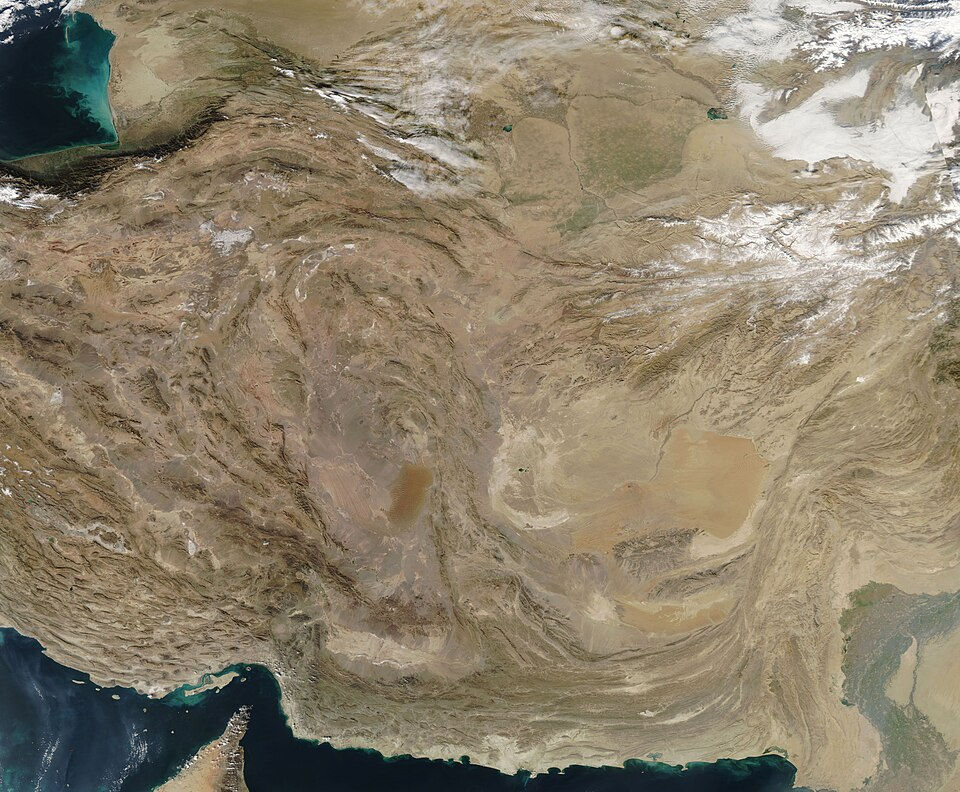
If one looks at a map, Iran’s strategic relevance becomes obvious. The country sits at the intersection of several critical regions: the Middle East, Central Asia and the Caucasus. It also borders the Persian Gulf, the maritime corridor through which a significant portion of the world’s oil exports passes. Just a few kilometers south lies the Strait of Hormuz, one of the most sensitive energy chokepoints on the planet. This geography gives Tehran a potential strategic lever: the ability to influence the flow of energy that sustains global economies.
No global power can ignore that reality.
Ideology is not the real issue
Public discourse often frames the confrontation between Iran and the United States as an ideological struggle: a revolutionary Islamic regime versus the Western liberal order. But in geopolitics ideology rarely explains everything. Analysts like Dario Fabbri often remind us that states do not primarily act out of ideological conviction. They act to secure their position in the international system. From this perspective, the confrontation between Iran and the United States is not a moral battle. It is a structural rivalry between a global power that wants to preserve regional balances and a regional actor that seeks strategic autonomy.
A regional system full of tensions
The Iran–United States rivalry is only one piece of a broader regional puzzle. The Middle East is shaped by a fragile balance among several actors, including Israel, Saudi Arabia, and Turkey. Each of these powers seeks security and influence. Iran tries to expand its strategic depth through alliances and proxy networks across the region. Its rivals respond by aligning—formally or informally—with Washington. The result is a landscape of indirect conflicts stretching from Lebanon to Yemen.

Why the tension will not disappear
For decades, diplomacy has tried to stabilize the relationship between Iran and the United States.
Negotiations over nuclear programs, partial agreements, sanctions relief, and temporary de-escalations have all produced moments of reduced tension. But none of these initiatives has resolved the underlying geopolitical question. Who will shape the balance of power in the Middle East? As long as Iran continues to seek regional autonomy and the United States continues to prevent the rise of dominant regional actors, the rivalry between the two countries will remain part of the region’s strategic landscape.
The confrontation between Iran and the United States is not simply the product of diplomatic crises or ideological hostility. It is rooted in geography, power distribution and the strategic logic that governs international systems. That is why the tension never truly disappears. It can intensify or fade, escalate or stabilize—but it remains. Because in geopolitics, some conflicts are not temporary disputes. They are structural realities.
This article is part of the Grey Zones Archive, a research project exploring the strategic spaces where geopolitics operates beyond official narratives.
The narrative universe connected to these themes appears in the geopolitical thrillerThe Naacal Protocol – Code 211 by Adelio Debenedetti.
Next article in the series: Strait of Hormuz: The Oil Chokepoint That Could Shake the Global Economy


Adelio Debenedetti’s article delivers a highly structured and technically grounded interpretation of the Iran–United States conflict, moving beyond media-driven narratives to focus on the underlying geopolitical logic. By framing the tension as a structural phenomenon rooted in geography, power distribution, and long-term strategic continuity, the analysis provides a level of depth that is often missing in mainstream commentary.
What clearly emerges is that the confrontation between Washington and Tehran is not a sequence of isolated crises, but a textbook example of Grey Zone geopolitics, where persistent competition unfolds without formal war. In this sense, the Zona Grigia project confirms its relevance as a platform for Grey Zone warfare analysis, offering a coherent framework to interpret indirect conflict dynamics.
The article…