The Arctic Is No Longer Empty

How Svalbard, the GIUK Gap and Arctic geopolitics are reshaping the silent geography of power
by Adelio Debenedetti, author of The Naacal Protocol – Code 211
For decades, the Arctic was treated as a geopolitical margin. A frozen expanse at the edge of global strategy.Remote, hostile and economically secondary compared to Europe, the Middle East or the Pacific. Even during the Cold War, much of the polar north was perceived mainly as a military transit zone — important for submarines, radar systems and nuclear deterrence, but still distant from the true political center of gravity. That perception is disappearing. The Arctic is rapidly transforming into one of the most strategically sensitive regions on Earth, and places once considered isolated are becoming increasingly central to the architecture of modern power.
Svalbard is one of the clearest examples of this transformation.
Svalbard and the return of Arctic geopolitics
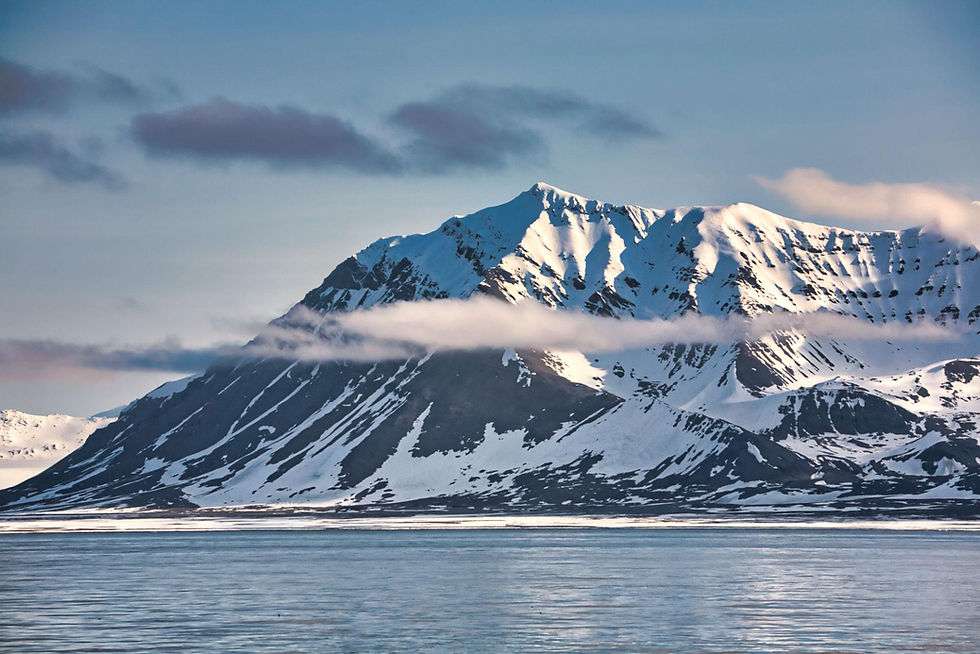
At first glance, the Norwegian archipelago still appears peripheral:a small civilian population, extreme climate, mining settlements,scientific stations,polar tourism. But modern geopolitics rarely depends on appearances alone. The true importance of Svalbard lies in its position inside a wider strategic system connecting:Arctic shipping routes,North Atlantic security,Russian naval access,undersea infrastructure,satellite surveillanceand NATO Arctic strategy. This is why settlements like Barentsburg matter far beyond their economic value. Barentsburg survives largely through Russian state support despite limited industrial profitability. From a purely financial perspective, maintaining the settlement makes little sense. From a geopolitical perspective, however, the logic becomes extremely clear:presence itself has become strategic.
Barentsburg and the logic of strategic presence
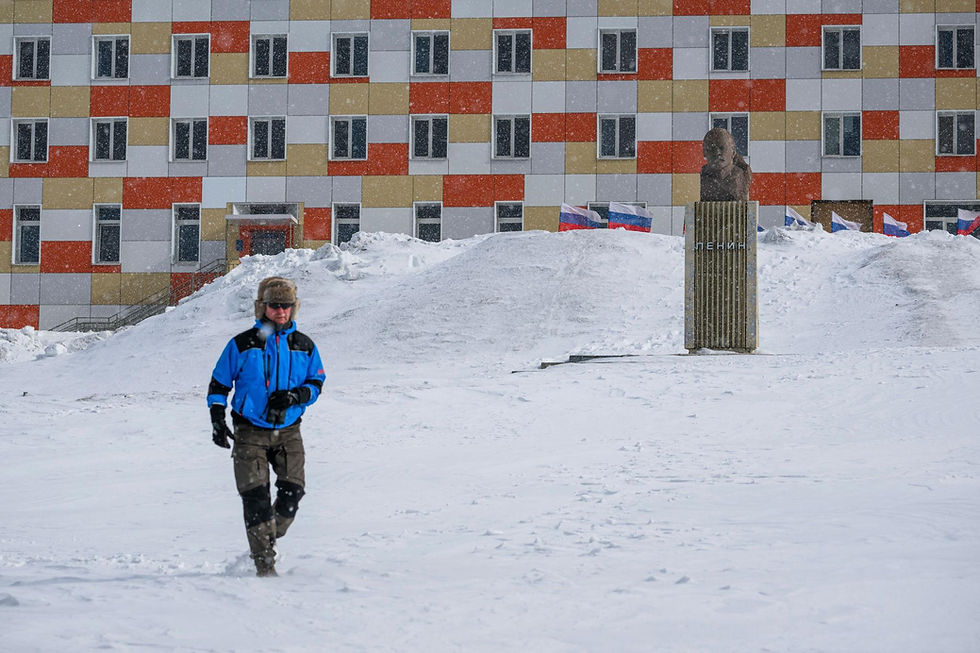
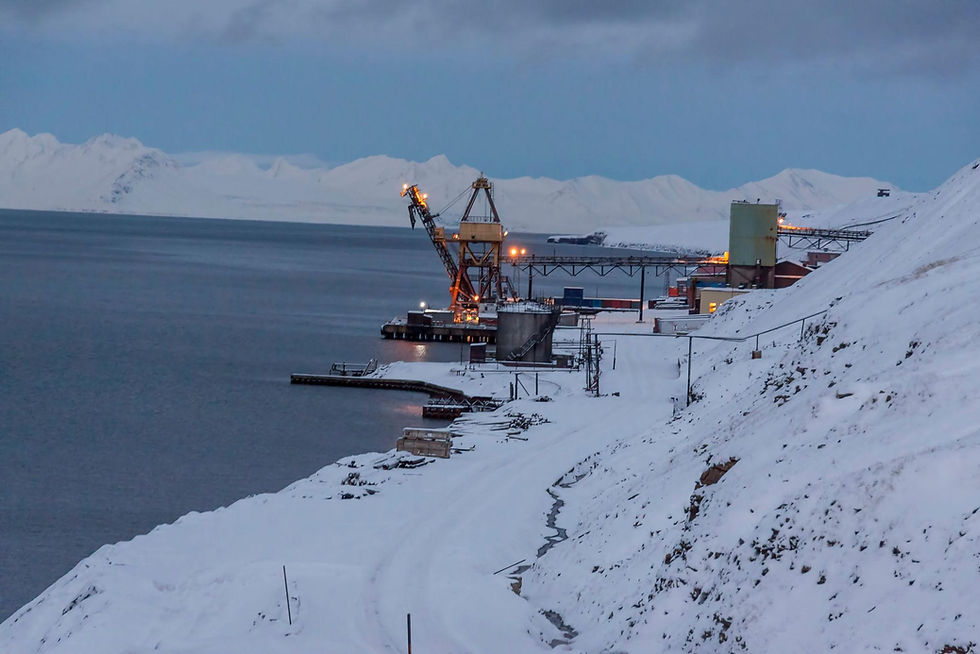
In the Arctic, geography magnifies infrastructure. Every port,airstrip,communication systemor logistics facility acquires disproportionate strategic value once operational distances expand across polar conditions. What appears civilian on paper can become strategically significant simply because it exists in the right place. This is one of the defining characteristics of modern grey zone competition. Strategic rivalry increasingly operates below the threshold of open confrontation. Instead of overt militarization, states use:civilian infrastructure,scientific activity, energy logistics, legal agreements and persistent territorial presence to shape long-term influence. Svalbard is almost a perfect laboratory for this model. The Svalbard Treaty formally demilitarized the archipelago while allowing foreign economic activity under Norwegian sovereignty. The treaty was designed for a very different century — one in which Arctic geography still appeared strategically marginal. Today, the same legal framework generates strategic ambiguity. Russia maintains civilian settlements.Norway reinforces governance and Arctic infrastructure. NATO monitors developments across the High North with increasing attention. Scientific facilities coexist with satellite systems, maritime monitoring and strategic communications architecture. Nobody officially militarizes the territory. Yet the region grows steadily more strategic every year.
The GIUK Gap and the new strategic geography of the North Atlantic
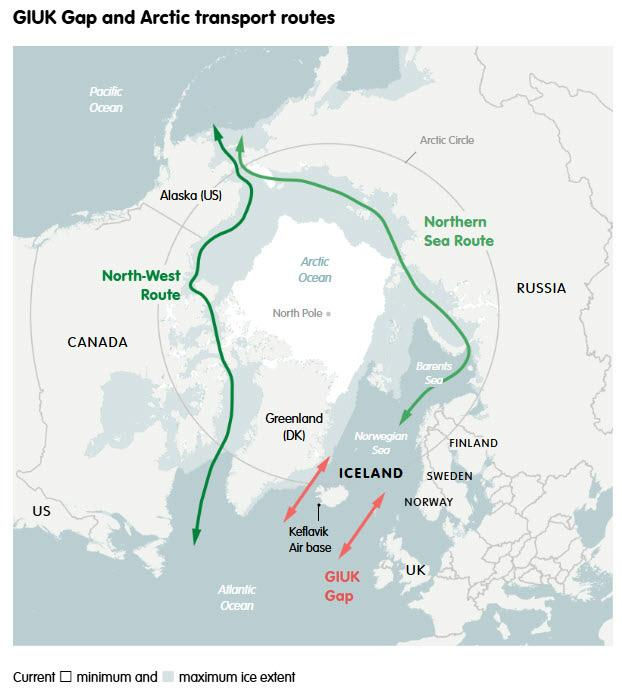
This ambiguity extends well beyond Svalbard itself. Across the wider Arctic, melting ice is reshaping maritime geography. Polar shipping routes are becoming more accessible.Resource competition is intensifying.Undersea communication infrastructure is gaining strategic visibility after repeated concerns surrounding cable vulnerability and maritime sabotage risks. The Arctic is no longer a frozen void between continents. It is becoming an operational corridor. That reality reconnects the region directly to the GIUK Gap — the maritime corridor between Greenland, Iceland and the United Kingdom that remains one of NATO’s most important strategic chokepoints. During the Cold War, the GIUK Gap served as a containment and surveillance line against Soviet submarine movement into the Atlantic. Today, its role is evolving again under the pressure of:Arctic geopolitics,Russian naval modernization,undersea infrastructure vulnerability and renewed North Atlantic security concerns. The strategic map of the northern hemisphere is slowly reconnecting. Svalbard, Greenland, Arctic sea routes, subsea cables and the GIUK Gap increasingly form part of the same geopolitical system:a northern strategic corridor where infrastructure, surveillance and positioning matter as much as conventional military deployment.
Hybrid warfare and the future of Arctic competition

This is also why the Arctic is becoming deeply connected to the future of hybrid warfare and cognitive warfare. Modern influence is no longer based solely on territorialThe Arctic is rapidly becoming one of the world’s most strategic grey zones. From Svalbard and Barentsburg to the GIUK Gap, this analysis explores how Arctic infrastructure, Russian presence and North Atlantic security are reshaping the future of geopolitics beyond traditional military confrontation. conquest. It increasingly depends on:perception,access,logistics,continuityand the ability to maintain strategic presence without triggering open escalation. Civilian infrastructure can shape military calculations. Scientific stations can reinforce geopolitical legitimacy. Economic activity can preserve long-term strategic access. The distinction between civilian and strategic space becomes progressively harder to define. And that may be the most important lesson emerging from Svalbard itself. Barentsburg is not merely a mining town. Pyramiden is not merely a Soviet ghost settlement. The Arctic is not merely empty territory. These places reveal how 21st century power increasingly operates through persistence rather than visibility. The future geopolitical frontier may not be defined by dramatic invasions or visible occupations, but by the silent ability to remain present inside legally ambiguous spaces while the strategic value of those spaces continues to grow. That is why the Arctic matters now. And it is why the competition unfolding across the polar north may eventually shape far more than the future of the region itself.
This article is part of the Grey Zones Archive editorial project, a long-form analysis series focused on Arctic geopolitics, strategic chokepoints, cognitive warfare, hybrid conflict, dual-use infrastructure and the evolving balance of power in the 21st century. The analyses published on The Naacal Protocol Blog explore the increasingly blurred line between intelligence, strategic geography and contemporary geopolitical narratives, in continuity with the research-based universe of The Naacal Protocol – Code 211 by Adelio Debenedetti.


Comments