Global Chokepoints: How the United States secures strategic maritime routes

By Adelio Debenedetti, author of The Naacal Protocol – Code 211
Geography still determines power
Throughout history, great powers have always tried to control one fundamental element: trade routes. Before the industrial era this meant controlling ports and fleets. Today it means guaranteeing access to the strategic passages through which global trade flows. Roughly 90% of global commerce moves by sea, and a large share of that traffic passes through a handful of narrow maritime corridors known as chokepoints. These geographic passages function as the arteries of the global economy. Control—or simply the ability to protect them—remains one of the key foundations of geopolitical power. For the United States, maintaining the security of these routes has long been a central pillar of global strategy.
The strategic chokepoints of the global system
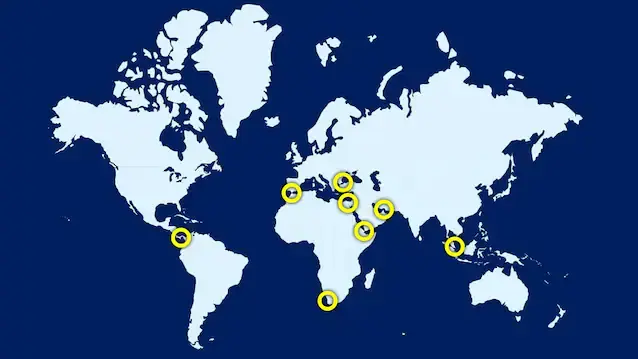
A small number of maritime passages concentrate an enormous share of global trade and energy flows. Among the most important are the Strait of Hormuz, the Strait of Malacca, the Suez Canal, the Panama Canal and the Bab el‑Mandeb. These locations function as the pressure points of global trade. If even one of them were disrupted, the consequences would ripple rapidly across global energy markets, maritime transport networks and international supply chains. In an interconnected global economy, chokepoints have become critical strategic assets.

The American maritime doctrine
Unlike historical colonial empires, the United States does not necessarily seek to own these geographic passages. Instead, its strategy focuses on something slightly different. The objective is to ensure that no rival power can dominate them. This logic traces back to the ideas of naval strategist Alfred Thayer Mahan, who argued that control of sea lanes was essential for global influence. In the modern era this principle translates into forward naval presence, strategic alliances and access to military bases near key maritime corridors. Together, these elements allow Washington to maintain influence over the maritime infrastructure of global trade.
The Persian Gulf and the energy lifeline
One of the most sensitive regions within this strategy is the Persian Gulf. A significant portion of the world’s oil exports passes through the Strait of Hormuz, making it one of the most important energy chokepoints on the planet. For this reason the United States maintains a substantial naval presence in the region and a network of partnerships with Gulf states. The strategic goal is not necessarily to control the passage itself. Rather, it is to ensure that global energy flows remain uninterrupted. This principle has guided American policy in the region for decades.
Maritime routes and great-power competition
In recent years the issue of maritime chokepoints has returned to the center of geopolitical competition. One of the reasons is the expanding global presence of China. Through investments in ports, infrastructure and logistics networks, Beijing has been extending its economic influence along major maritime corridors connecting Asia, Africa and Europe. These developments are often discussed in the context of China’s Belt and Road Initiative. As a result, maritime routes that once appeared purely commercial are now increasingly viewed through a strategic lens. For Washington, maintaining secure access to these corridors remains a key component of global stability.

From Greenland to the Arctic routes
The logic of maritime control is not limited to the Middle East. In recent years strategic attention has also turned toward regions such as Greenland and the Arctic. Climate change is gradually opening new northern shipping routes that could connect the Atlantic and Pacific Oceans more directly. If these Arctic corridors become commercially viable, they could reshape global trade patterns. This possibility explains why Arctic territories are gaining strategic relevance. Control, access and monitoring of these regions may become increasingly important for global powers.
The Iran–U.S. connection
The confrontation between Iran and the United States fits directly into this broader strategic framework. Iran’s geography places it near the entrance to the Strait of Hormuz, giving Tehran potential leverage over a key global energy corridor. In times of crisis, this position could allow Iran to exert pressure on international energy flows. For Washington, therefore, the confrontation with Iran is not only about regional influence. It is also about safeguarding the stability of one of the world’s most critical maritime chokepoints.
The balance of the global system
Today the international system is evolving toward a more complex balance of power. On one side, the United States continues to act as a guarantor of open sea lanes and global trade flows. On the other, emerging powers are attempting to diversify routes and reduce dependence on Western-dominated infrastructures. Within this environment, maritime chokepoints remain central nodes of global strategy. They are not simply geographic passages.
They are control points of the global economic system.
In the contemporary world, power is measured not only by military strength or economic size. It is also defined by the ability to secure—or potentially disrupt—the flows that sustain the global economy. For this reason, maritime chokepoints remain one of the most important foundations of geopolitical power. The tension between Iran and the United States represents just one chapter of this broader strategic reality. A reality in which geography, energy and trade routes continue to shape the balance of global power.
This article is part of the Grey Zones Archive, a research project exploring the strategic spaces where geopolitics operates beyond official narratives. The narrative universe connected to these themes appears in the geopolitical thrillerThe Naacal Protocol – Code 211 by Adelio Debenedetti.
Next article in the series: Iran–U.S. Conflict and Global Chokepoints: The Geography of Modern Power

Comments