Hidden Programs: From Nazi Experiments to Modern Cognitive Warfare

By Adelio Debenedetti – Archive 211
When people speak of Nazi science, they often imagine crude experiments, pseudoscientific rituals, and ideological madness. But beneath the mythology, something far more strategic was taking place. During WWII, several research units—most notably the Ahnenerbe, the Reich Main Security Office (RSHA), and select divisions of the Wehrmacht Medical Service—initiated programs aimed not at creating weapons in the traditional sense, but at exploring how perception could be influenced, fractured, or redirected.
Historians continue to debate the scientific credibility of these efforts. What matters geopolitically, however, is not whether the Nazis produced reliable results.What matters is the methodology—and the legacy it left behind.

Source: Wikimedia Commons – Public Domain
Perception as a weapon
Within classified reports and post-war interrogations, Allied intelligence repeatedly encountered recurring themes:
Early neuro-perceptual manipulationAttempts to map emotional responses to symbols, shapes, and frequencies.
Symbolic saturationFlooding controlled environments with repeated geometric motifs to provoke behavioral alignment or disorientation.
Frequency-based conditioning prototypesPrimitive tests exploring how rhythm, sound patterns, or flicker rates might affect cognitive processing.
Military mythmakingThe integration of ideological myth, sacred geometry, and archetypal symbols into training and propaganda campaigns.
These programs were experimental and often unethical.But they shared a common objective:
Domination required more than physical control. It required cognitive dominance.
This shift—from conquering territory to conquering perception—was decades ahead of its time.
The post-war extraction machine

Source: Wikimedia Commons – CC BY-SA 3.0
After 1945, the Allied powers competed fiercely to capture not just Nazi scientists, but archives, experimental notes, psychological mappings, and symbolic research.
Through programs such as Operation Paperclip, the CIA and other agencies collected vast amounts of unconventional research. Much of it was dismissed as ideological nonsense. But certain strands—especially those related to perception, suggestion, sensory modulation, and symbolic imprinting—were quietly preserved.
Similar efforts took place in the Soviet Union.Declassified GRU and KGB documents show parallel interest in:
perceptual denial techniques
identity fragmentation
deep-state influence operations
behavioral conditioning under sensory load
This marked the beginning of what is now known as cognitive warfare.
Cognitive Warfare. From propaganda to perception corridors

Source: Wikimedia Commons – CC BY-SA 4.0
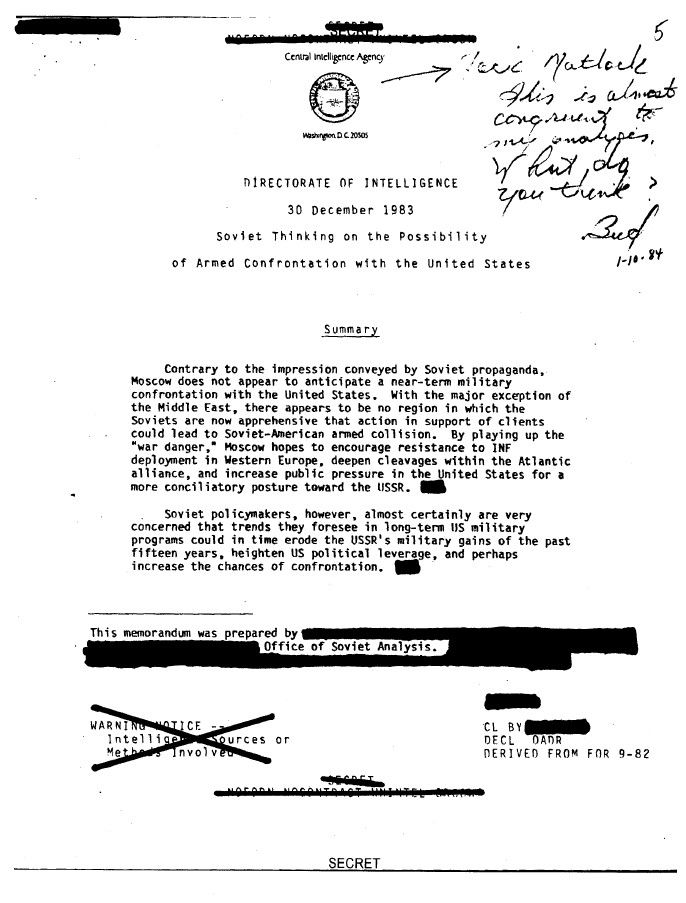
By the late Cold War, Western and Soviet intelligence had independently developed a series of doctrines that echoed the early Nazi experiments:
Perception corridorsShaping the range of reality that targets can see, rather than controlling the content they consume.
Narrative steeringGuiding populations toward predetermined interpretations without issuing direct instructions.
Memetic implantationEmbedding ideas into symbolic structures, images, and recurring cues.
Identity fragmentationEncouraging division, confusion, and cognitive overload as strategic tools.
At that point, the battlefield had shifted decisively inward.The objective was no longer to destroy the enemy’s capacity to fight. It was to destabilize how the enemy interprets the world.
A legacy woven into the shadows
What makes this history unsettling is not the nature of the experiments themselves, but the continuity of the ideas.
Modern cognitive warfare—conducted not only by states but by corporations, platforms, and algorithmic systems—shares the same core premise:
Control perception,and you control action.
The tools have changed.The objective has not.
The Naacal Protocol – Code 211: a synthetic evolution
In The Naacal Protocol – Code 211, these historical programs are not forgotten relics. They form the skeleton of a covert architecture that merges:
ancient symbolic knowledge
Nazi-era perceptual research
Cold War cognitive doctrines
modern neurotech and behavioral algorithms
The result is not a weapon that kills. It is a system that rewrites minds—not through force, but through the restructuring of perception itself.
A technique hinted at in wartime experiments, refined through Cold War strategy, and perfected in the digital age.
The past was not merely brutal. It was foundational.
And its shadow reaches all the way into the 21st-century battlespace—a battlespace where perception is territory, and the mind is the final frontier.
Explore more: visit the official project hub at www.protocollonaacal.it/en/blog for in-depth articles, behind-the-scenes research, and direct links to the novel Il Protocollo Naacal – Codice 211.


Comments